
Video Wednesday: White House Kitchen Garden
Labels: edibles, public gardens, video, video. historic gardensA quick video overview of what was growing in the White House Kitchen Garden during October 2012.

Think Seeds!
Labels: seed exchange, seed swap, seeds
Mark your calendars for our next Washington Gardener Magazine Seed Exchanges:
~ January 25, 2014 at Brookside Gardens in Wheaton, MD
~ February 1, 2014 at Green Spring Gardens in Alexandria, VA
And let us know what you grew this year from seeds you got at this years' Washington Gardener Magazine Seed Exchanges. We'd love to see photos and hear your success stories! You can post to the comments section below or send an email to Wgardenermag@aol.com with 'Seed Success' in the subject line.
Happy Growing!
National Ag Library Tour Invitation
Labels: tour, USDA Washington Gardener Magazine is hosting a tour day of the National Agricultural Library in Beltsville, MD, for local garden clubs and select guests on Saturday, August 10 from 10am-12noon. The National Agricultural Library is normally open to the public only during regular business hours, so this is a special opportunity for those who work full-time or those who are not in the DC area to travel to town for it. The tour will include a behind-the-scenes look at the library’s special collections. From actual specimens brought back by USDA explorers to vintage seed catalogs, this library is a treasure-trove of garden history and research. If any local gardeners would like to attend this event, they should RSVP with their full names to WGardenermag@aol.com before 12noon Thursday, August 8. Note that the NAL is a secure Federal property therefore a photo ID and advance registration is required.
If you have been on the NAL tour with us before, Susan Fugate, head of NAL special collections, promises us she will be pulling out some rare materials not seen on any previous tour and will be sharing some digital collection updates. Susan also advises that you bring your checkbook if you wish to purchase anything from their licensed properties as the NAL does not take cash or cards.
I have gotten a few inquiries asking why visit the National Agricultural Library and what is so special about it? I think the easiest way to explain it is to share with you an excerpt from the DayTrip column we published about the collection in our Jan/Feb 2008 issue of Washington Gardener Magazine:

Inside the NAL is a vast collection of resources that are unavailable online. Much of this collection is not readily available from other sources. Some of it is one-of-a-kind and only resides at the NAL. The NAL staff is just at the beginning of a decades-long project to get many of these rare items on the web. It is a painstaking endeavour and federal funding for the undertaking is in short supply. “For over a decade, the NAL has suffered from benign neglect when it comes to federal budget appropriations,” observes John Peter Thompson, president of the National Agricultural Research Alliance — Beltsville. “Without national stakeholders applying pressure for new money, the library has been unable to secure necessary funding. Write or call your Congressmen and send a copy of the letter to the Secretary of Agriculture to urge them to address the inadequate budget appropriations.”
We are indeed fortunate to have this wonderful resource in our own backyard, so to speak, and easily accessible to DC-area residents. While we may think today we can look up anything on Google, it is simply not true. The vast majority of plant research and records is not available anywhere on the Web. A trip to the NAL is well worth your time to get a close look at just a fraction of what research is actually out there in the horticultural world.
Here are just a few of the exclusive NAL collections you can visit in person:
• Over 200,000 nursery and seed catalogs — old and new.
• Tens of thousands of photographs of plants and gardens around the world — some taken by plant explorers along with detailed notations in their travel journals.
• J. Horace McFarland collection of photos and negatives of gardens and plants which includes original art for horticultural books and nursery catalogs his printing company produced.
• Research records of the US National Arboretum; lots of history of those gardens.
• Botanic Garden Photograph Collection; mainly US sites, but some international.
• A full set of the Curtis’s Botanical Magazine.
• 15,000 rare books — probably two-thirds of which are on plant sciences.
• Herbals -- quite old and fragile, but useful today for identifying medicinal plants.
• A comprehensive collection of bulletins published by USDA.
• Over 7,000 watercolors of fruits and nuts with a few vegetables in the USDA Pomological Watercolor Collection — 1880s to 1914. (Pomology is the science of fruit breeding and production. Did you know that where the Capital Beltway (I-495) cuts through College Park and Beltsville was a vast USDA fruit research orchard, which has now moved to near Kearneysville, WV?)

The library’s 15-story Abraham Lincoln Building is named in honor of the president who created the Department of Agriculture and signed many of the major US laws affecting agriculture. Lincoln’s background as a pioneer farmer on what was then the western frontier and his years as a country lawyer made him a representative of the frontier, the farmer, and small town democracy.
He had a desire to see agricultural research given a central role and greater investment by the government so that farmers using their own labor or hiring labor (i.e., free men) could grow food and produce related goods profitably. He urged more efficient and intensive cultivation in order to increase production to the full capacity of the soil.
NAL was created with the USDA in 1862, and established as a national library by the Congress to be the primary agricultural information resource of the United States. Congress assigned to the library the responsibilities to:
• Acquire, preserve, and manage information resources related to agriculture and allied sciences;
• Organize agricultural information products and services, and provide them within the United States and internationally;
• Plan, coordinate, and evaluate information and library needs related to agricultural research and education;
• Cooperate with and coordinate efforts toward development of a comprehensive agricultural library and information network;
• Coordinate the development of specialized subject information services among the agricultural and library information communities.
NAL is the only library in the United States with the mandate to carry out these national and international responsibilities for the agricultural community.
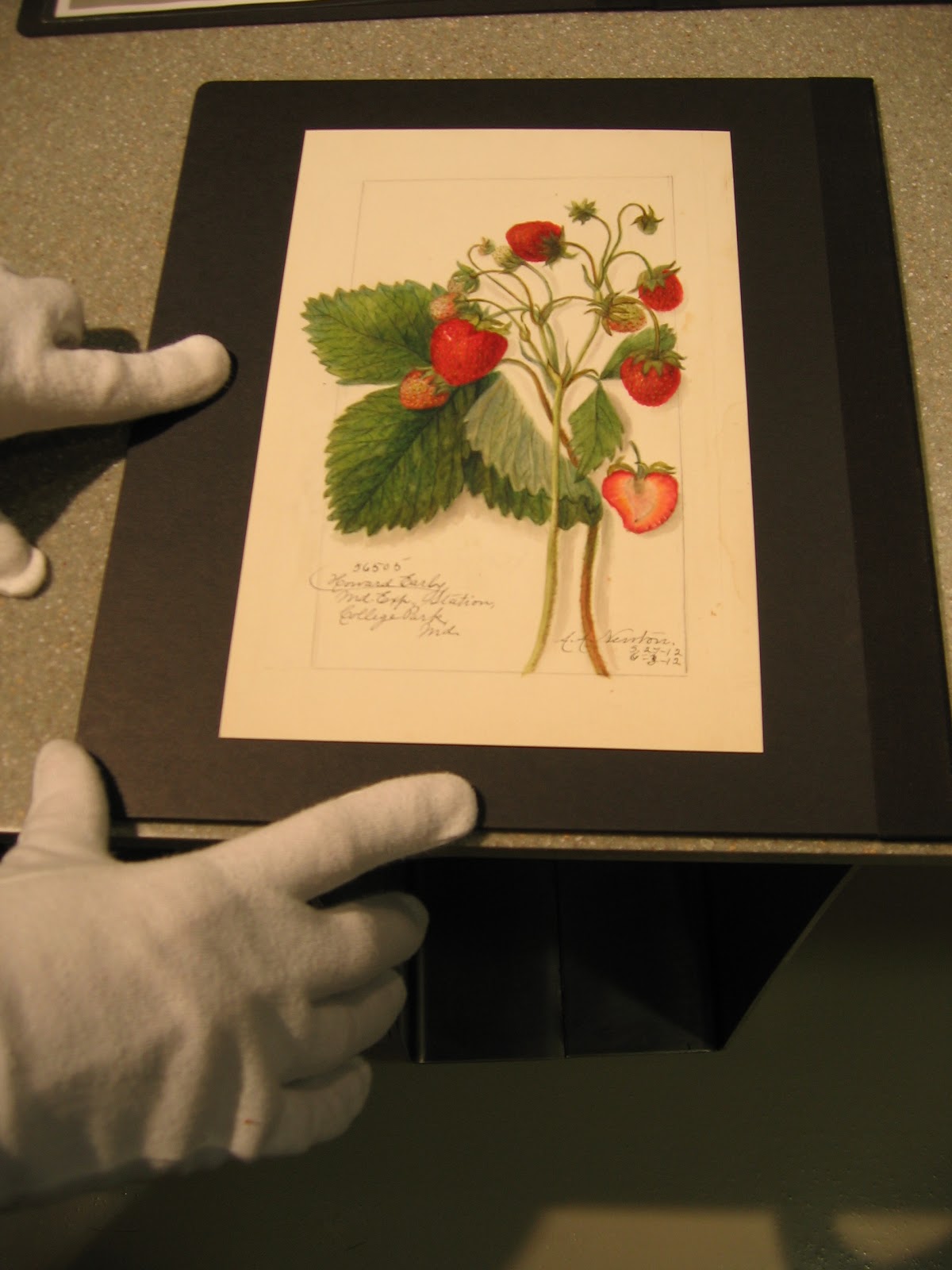
The NAL collections contain nearly 3.6 million items covering all aspects of agriculture and related sciences, and are a comprehensive resource for agricultural scientists, policy makers, regulators, and scholars. The origins of the library’s collections date to the congressionally approved 1839 purchase of books for the Agricultural Division of the Patent Office, predating the 1862 establishment of the USDA itself. The collections date from the 16th century to the present, including the most complete repository of U.S. Department of Agriculture publications and the most extensive set of materials anywhere on the history of agriculture in the United States.
Currently, the NAL initiates and coordinates these exchanges with over 5,000 partners from 106 countries worldwide, accounting for about 70% of all periodicals currently received.
Additional Offerings
In addition to the fabulous botanical treasures in its special collections (only some of which are viewable online at http://www.nal.usda.gov/speccoll/) the National Agricultural Library has a treasure-trove of horticultural publications in its collections, which can be borrowed through your local public library or Land Grant University Library (http://www.nal.usda.gov/services/request.shtml).
The Library’s Alternative Farming Systems Information Center (AFSIC) (http://afsic.nal.usda.gov/nal_display/index.php?tax_level=1&info_center=2) carries a lot of specialized information on horticulture and on organic agriculture. Mary Gold of AFSIC is one of the Master Gardeners in the library and is happy to assist in answering your questions. The NAL employs about 165 librarians, information specialists, computer specialists, administrators, and clerical personnel, supplemented by about 80 contract staff, cooperators from NAL partnering organizations, and volunteers.
The NAL also operates the National Invasive Species Information Center (http://www.invasivespeciesinfo.gov/), which is an excellent gateway to invasive species information; covering Federal, State, local, and international sources.
So that gives you a little taste of what you'll discover on our three-hour-tour of the National Agricultural Library. I hope you can join us and please do RSVP soon as spaces will fill fast.
Fenton Friday: Nieces Pick Me Clean
Labels: edibles, Fenton
My nieces also came by this week and they helped me at the Fenton Community Garden plot with watering and a touch of weeding. Mostly though, they ate all the cherry and currant tomatoes. They could not get enough of the 'Sun Gold' -- if you have kid's that won't eat their veggies, this is definitely the tomato that will change their minds.
Pictured here was a visit we made to the Victory Garden at the Smithsonian's American History Museum. Joe Brunetti (at left) is the lead horticulturist at the garden and took a few minutes to show us around -- pointing out the more unusual Cotton, Roselle (Hibiscus sabdariffa), and Passionflower plants.
Back at my garden plot, we also picked a half row of carrots for snacks during their visit, so I planted new carrot seeds in their place. The new seeds are 'Little Babette' French baby carrots. Now is the time to start second-season (aka Fall) crops, so I need to start sorting seed packs and planning what I want to put in this next week.
Video Wednesday: Time-Lapse Opening of Titan Arum at USBG
Labels: public gardens, videoIn case you missed seeing it in-person, this video is a time lapse of the bloom of the titan arum (corpse flower) at the U.S. Botanic Garden, created from photos taken from Sunday afternoon through Monday morning. The titan may remain in bloom for 24 to 48 hours, and then it will collapse quickly. Learn more at: http://www.usbg.gov/return-titan.
Win Mr Natural Organic Soil Products

Mr. Natural® ORGANIC Soil Products are the first choice of world class botanical gardens and institutions, respected museums and universities, renowned golf courses, landmark buildings and parks, public and private venues of all kinds, over 1500 top landscape companies and legions of happy, ardent gardeners. Mr. Natural soils teem with the microbiological and other life forms that restore damaged soil structure and bring nearly perfect nutrition to plants. Find out more at http://greenstripe-products.com/.
To enter to win one of the four bags of Mr. Natural® products, send an email with “Mr. Natural” in the subject line to WashingtonGardener@rcn.com by 5:00pm on Thursday, July 25. In the body of the email please include your full name, email, address, and tell us: What is Your Favorite Story in the Spring 2013 issue of Washington Gardener Magazine and why. The winners will be announced and notified by July 26 and will need to arrange to pick up their prize by July 28. Note that each bag of soil is one cubic foot and weighs about 30 pounds. Some of the entry responses may be used in future online or print articles.
UPDATE: Congratulations to our contest winners -- Sue Hauser, Nina Bang-Jensen, Sally Smyth, and Jacob James. We hope you enjoy your Mr. Natural soil products!
UPDATE: Congratulations to our contest winners -- Sue Hauser, Nina Bang-Jensen, Sally Smyth, and Jacob James. We hope you enjoy your Mr. Natural soil products!
Gather Ye Images While Ye May

Are you gathering images for next year's Washington Gardener Magazine Garden Photo Contest yet? Remember our rules: photos must be taken within this calendar year and in a garden-setting within 150-miles of the US Capitol building. We are looking for garden images in ALL seasons.
We will start accepting the next garden photo contest submissions on January 1, 2014, but you will kick yourself if you are not taking, gathering, and sorting your garden images through out 2013 in preparation for it.
Every year I hear from people who wish they'd started collecting their images earlier and missed out on the contest entry deadlines. This year, I'm giving plenty of advance notice and will repeat the reminders every few months.
For a little inspiration, here is a link to our 2013 winners:
You can also view the winning photos on display now through August 25 at Meadowlark Botanical Gardens in Vienna, VA.
Subscribe to:
Posts (Atom)


